
Western Painted Turtle
(Chrysemys picta bellii)
With help from us, these neighbours are re-building their community.

The Western Painted Turtle (Chrysemys picta bellii) is the largest subspecies of painted turtle in Canada and British Columbia's only native freshwater pond turtle.
If they can get through their infancy, these turtles may live for 30 years; some references state they may be capable of living over 50 years in the wild.
Thanks, in part, to human intervention in recent years, the Western Painted Turtle continues to appear in Hotel Lake and we hope to see them thrive.

Range
Canada hosts three subspecies of painted turtle. Two are found in eastern Canada. The Western Painted Turtle is found in the north-western USA and in British Columbia.
According to Reptiles and Amphibians BC, “The Western Painted Turtle is the only native pond turtle left in British Columbia.”
The range map of BC and the enlarged zoom-in shows that Western Painted Turtles are “Present” in the general area of the Sunshine Coast. In certain areas, particularly in the Pender Harbour area, they are depicted as “Extant”, a subtle distinction meaning that their existence is a fact that stands out and is notable.

Habitat
Western Painted Turtles inhabit lakes as well as ponds, wetlands, rivers and slow creeks. They prefer smaller water bodies and sheltered bays with soft-muddy bottoms. In winter, these turtles hibernate in the muddy bottom near shorelines.
They are seen sometimes along riparian landscapes but more frequently in the water amongst floating logs along healthy shorelines with aquatic vegetation.
Colourful sunbathers, they are most often observed and photographed basking on logs, rocks or shorelines that provide easy access and also a fast escape back to the safety of the water.


Characteristics - Anatomy
The Western Painted Turtle is the largest of the three subspecies of painted turtle, with a shell length that can reach 20-30 cm in females and 11-19 cm in males.
The upper shell, called “carapace", is smooth and rounded with dark black to olive green colouration, often overlaid with a net-like pattern of faint light-yellow, orange, or red worm-like markings.
The marginal “scutes” (enlarged scales on the outer edge of the shell) have bright orange or red markings.
The turtle’s underside is called a “plastron”. It is bright red or orange and features a large dark irregular “butterfly” marking in the centre on either side of the midline.
The head and four limbs are dark black and green decorated by conspicuous yellow stripes on the head and neck.
Their hind feet are substantially webbed while their front feet feature skinny claws; male claws are much larger than females.
Hatchlings are tiny, with a carapace length of about 2.5 cm. They appear as perfect miniatures of the adult except their carapace is noticeably more keeled and their heads, legs, and tails are slightly larger, relative to their shells. The hatchling below was seen in Hotel Lake on May 22, 2026, it's shell, about the size of a “toonie"

With all this care and attention we hope that the painted turtle population in Hotel Lake will grow and that the species will thrive. In July of 2022 we were able to record this very short video of an inquisitive painted turtle who passed close-by so that we could see how they swim; what a wonderful thing to see!
Life Cycle
Western Painted Turtles take many years to reach sexual maturity. Depending on latitude, males are sexually mature somewhere between 4 and 10 years and females, between 7 to 15 years.
Mating begins after turtles emerge from hibernation in the spring and continues throughout the summer and early fall. Courtship usually takes about 15 minutes. The female is enticed to follow the male, then they sink to the bottom to mate.
Female turtles may mate with more than one male during a breeding season and have clutches with multiple paternities. A female can also store viable sperm for more than a year.
In May, June and early July, females will generally dig their flask-shaped birthing-nests in open soil or grassy areas on south-facing slopes within 200m from water. To avoid predators they often dig during nighttime. They dig with their hind feet and once the nest chamber is completed, they carefully lay and arrange 6–18 rounded eggs, each roughly the size of a two dollar coin.
Incubation lasts from 72 to 80 days and hatching takes place in August and September. Studies have shown that during the last few weeks of incubation, eggs exposed to mean temperatures warmer than 29°C tend to produce females, while cooler mean temperatures below 26°C tend to produce males. A mean temperature of 28°C produces males and females equally.
After hatching takes place the hatchlings usually remain in the nest for about 7-10 days consuming egg yolk material for sustenance. After that, some may emerge (leave the nest) and travel to a waterbody. Others, will remain in the nest to hibernate and emerge the following spring. Whether in the nest or in the open environment they are able to tolerate the encroaching winter weather down to about -10 °C.
Coastal Painted Turtle Project, turtle monitoring technician, Brigid Patterson explains: "In our coastal population an estimated 80% of hatchlings emerge from their nests in late August through September. Last year (2025) I found most nests laid in May and June came out in the fall, nests laid in July stayed in the nest chamber till the spring."
During the winter, the young turtles hibernating in nests are highly vulnerable to predation by many natural and domestic animals such as raccoons, skunks, coyotes, otters, mink, squirrels, various bird species and domestic cats and dogs. The predation rate may be as high as 90%. It is during this time as well as during the earlier incubation period that humans can make a real difference by installing simple-to-build protective cages to protect the nests. More about this later.
When the hatchlings finally emerge from their nest, they receive no parental care and are completely on their own. As they make the treacherous journey from their birth-nest to their aquatic home in Hotel Lake, they must avoid natural predators and navigate the many human-induced factors such as the destruction or erosion of fragile riparian zones and pollution. A great many turtles die every year under the wheels of automobiles travelling on roadways that are built close to and alongside waterbodies.
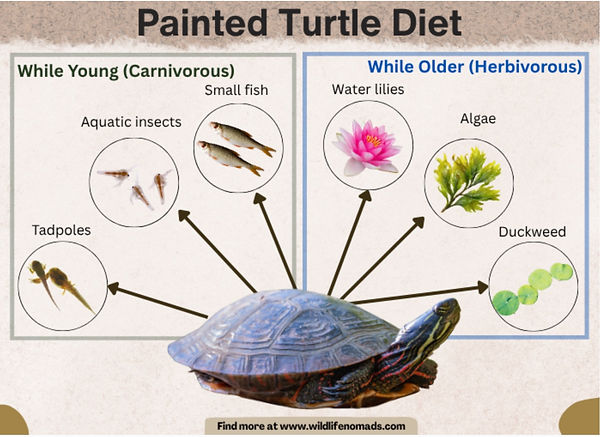
Once the young turtles establish in a water environment, they begin to hunt and feed themselves mainly on tadpoles, insects, crayfish and snails, graduating to bigger prey like fish and frogs as they get older. They grow rapidly and can double their size in the first year; generally, their growth rates are more rapid than other subspecies.
As cold-blooded reptiles and ectotherms, they cannot generate their own body-heat, so they rely on external heat sources, such as sunlight to raise their body temperature. By basking in sunlight, several times a day and also by seeking shade they control their blood temperature, optimize the digestion of food and also ward off fungus or parasites on their shells.
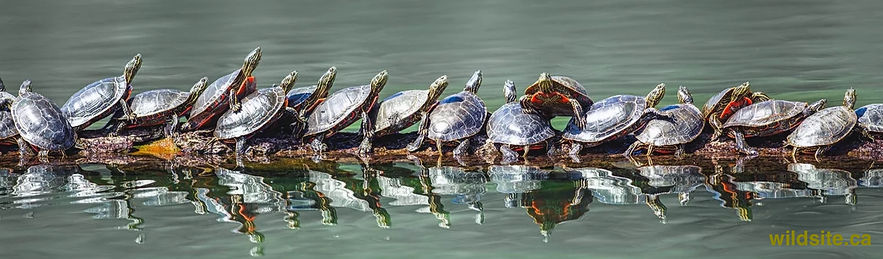
They are famous for sunbathing on logs and rocks and form crowds of turtles on the best ones. The best ones are situated in water which provides an instant escape route if they are threatened.
As you can see, air and water temperatures are the primary drivers in a painted turtle’s daily rhythm as well as its annual cycle, from spring emergence to winter dormancy.
When winter approaches and ambient air and lake water temperatures drop they overwinter within the soft and relatively warmer, shallow muddy bottoms of lakes and wetlands. The principle is the same, they seek the relative warmth of lake mud in which to hibernate. They emerge in the spring, when the water temperature rises above 6 degrees Celsius.
For additional information we recommend the following Government of Canada document located in our library, : Western Painted Turtle (Chrysemys picta bellii) Pacific Coast population: recovery strategy 2021
Foraging and Diet
As omnivores, young Western Painted Turtles are able to forage for and consume both plants and animals. They feed, opportunistically on tadpoles, insects, crayfish, snails and worms, graduating to bigger prey like fish and frogs as they get older. As they grow their diet also expands to include algae and aquatic plants.
Special Habits
Sometimes we see several individuals basking on logs floating in Hotel Lake. They do this because they must maintain an internal body temperature between 17–23 °C in order to digest food and have optimum strength and endurance. During the daylight hours these turtles will emerge from time to time and repeat a cycle of basking and foraging. When the sun sets, they drop to the bottom of the waterbody or perch underwater on a log and sleep until daylight.


Threats to Western Painted Turtles
In British Columbia significant wetland and riparian areas have been lost due to urban development and the loss of wetlands and ponds.
Loss of Wetlands and Ponds
When discussing wildlife in BC, wetland loss comes up again and again as a major threat. We cover this subject in our webpage titled “Draining a Wetland”. The following narrative on the historical destruction of wetlands is summarized in the following report titled: Western painted turtle (Chrysemys picta bellii) COSEWIC assessment and status report 2012. It is available at the following link: https://www.canada.ca/en/environment-climate-change/services/species-risk-public-registry/cosewic-assessments-status-reports/western-painted-turtle-2012.html
“In the Lower Fraser Basin, only about 1% of the original wetlands remained in 1990 (compared to pre-settlement in1820s), while urban and agricultural lands had increased to cover 26% of the basin landscape by 1990 (Boyle et al. 1997). In the Fraser River Delta, about 70% of the original wetlands have been altered by diking and drainage schemes (Habitat Group 1978). This includes virtually all of the seasonal wet meadows and 84.6% of the bog habitat (Butler and Campbell 1987). Sumas Lake wetlands (formerly one of North America’s most productive wetlands) were drained for agricultural uses in the 1920s (Environment Canada 1992). After World War II, over 2,800 hectares were diked and drained between Pitt Lake and Pitt River, creating the Pitt Polder, a lowland area converted to agriculture by diking and draining. Portions of Cheam Lake, Pitt Polder, and Hatzic Lake were also drained.”
Disturbance of Turtle Habitat, includes:
1. Human pollution, infilling and fragmentation.
2. Roads close to water that cause a great many females and their hatchlings traversing between nesting sites and water habitat to be struck by cars.
3. Predation by dogs, raccoons, skunks, coyotes and birds. Also, the illegally introduced Red-eared Slider turtles are appearing in lakes and are known to attack and harass other turtles, compete for food, and carry diseases and parasites that can have a devastating impact on Western Painted Turtle populations.
4. There is also the possibility that hybridization (interbreeding) may be occurring.
This species and its regional population are listed under the Federal Species At Risk Act (SARA) and may be subject to protections under the BC Wildlife Act. Habitat for this species may also be governed under provincial and federal regulations including the Fish Protection Act and Federal Fisheries Act as well as Regional and local municipal bylaws.

Recovery Efforts at Hotel Lake
Hotel Lake currently (2026) has one manufactured nesting beach on private property built and monitored, initially, by the Sunshine Coast Wildlife Project. This beach has seen significant turtle nesting activity, hatchlings and consistent sightings of multiple turtles basking on nearby logs.
Recently, oversight continues under the Coastal Painted Turtle Project and the aforementioned nesting beach continues to host nesting. In past years, hatchlings have been seen at a number of sunny locations around Hotel Lake, along with repeated sightings, during summer, of multiple turtles basking on floating logs.
But the number of turtles basking on the lake can fluctuate from year to year. In 2026, an informal survey of residents revealed that fewer turtles were seen basking around the lake that summer. So what is really happening to turtle numbers in Hotel Lake?

In August 2021 traps appeared on Hotel Lake. These were well labeled with an explanation that they were for a "turtle population survey". And here is one of the census-takers doing that work. With so much care and attention to numbers, we hope our population of Painted Turtles will thrive.
However, we have not been able to find any published data on this and so it is difficult to confirm our population trends at Hotel Lake. Also we are unable to find any data about the “release" of young turtles into our lake as has been done elsewhere in the Greater Vancouver area lakes in past years.
During the summer of 2026, many residents at Hotel Lake, commented that fewer turtles were seen basking. We do not have any data to support that so the best we can do is to take the time to learn more. On the other hand, lake-side residents, throughout this turtle’s range in BC, might be able to step in and assist with future population surveys and thereby improve our understanding.

What We Can Do To Help?
Turtles are an important part of lake ecosystems and they need our protection. Be aware of your activities in and around the lake. We know that they are nesting in many areas on the lake shore where sunlight penetrates. We should avoid interacting with turtles especially near their nesting sites, and when they are basking on logs or along the shoreline. Both basking and nesting are essential functions of their survival. So please keep in mind that Hotel Lake is their home too.
Here are a few suggestions:
-
When driving near lakes or streams in the spring or fall, anticipate that turtles, often in the evening hours, may be crossing the road between nesting sites and bodies of water.
-
Keep watch for non-native turtles and report them.
-
Keep a respectfull distance from turtles sun-basking on logs or rocks.
-
Keep dogs on a leash around known nesting areas.
Concerning the protection of nests:
-
During winter as well as during the earlier incubation period, humans can make a real difference by installing simple-to-build protective cages to protect the nests.
Concerning protection during winter hibernation:
-
Humans need to keep these hibernating turtles in mind during the winter. They are hibernating in the muddy bottom of the lake in relatively shallow areas such as along the shoreline. Any activity or work done that disturbs the lake bottom in these areas can easily kill hibernating turtles.
Concerning anglers unintentionally hooking turtles and what to do if you catch a turtle:
-
The Coastal Painted Turtle Project sees around 3 to 7 turtles hooked each year.
-
Handle with Care: Gently bring the turtle to shore if it is hooked or tangled.
-
Do Not Pull the Hook: If the hook is swallowed, cutting the line as close to the hook as possible is safer than pulling it out.
-
Call for Help: Contact the BC Conservation Officer Service or a local wildlife rehabilitation group, such as the Coastal Painted Turtle Project. (link below)

Coastal Painted Turtle Project
Link: paintedturtleproject
Quote from CPTP: "The Coastal Painted Turtle Project arose from work initiated by the Ministry of Environment in 2008. The main goals of this project were to assess the current status of endangered Western Painted Turtle populations, which were only known in a few locations throughout coastal BC. In addition, assessing and addressing threats such as road mortality and habitat loss or degradation on a site by site basis was essential to create a plan for long-term recovery of coastal populations.
Results of the first few years of population surveys and habitat assessments determined that the majority of occupied sites had 5 or less turtles remaining. At sites with still active breeding populations; only 2 significant ones in the Lower Mainland and Fraser Valley, habitat restoration including the installation of nesting and basking habitat were essential to provide the critical habitat features the turtles need to ensure long-term survival and recruitment of young turtles. Low recruitment of juvenile turtles is often the limiting factor in population maintenance and recovery.
Turtles are most vulnerable when they are in the egg and hatchling stage. The ability to rear the young in a monitored environment allows for better survival rates for these turtles upon release. To this day, more than 400 turtles have been safely released in some of Metro Vancouver’s regional parks with the work of our partners; Wildlife Preservation Canada, the Greater Vancouver Zoo and the Ministry of Forests, Lands and Natural Resource Operations. Each turtle raised in captivity is fixed with its own unique pit tag. When a turtle is captured, we scan the tag and all the information for that individual is sent to our database. This allows us to track growth and genetic lines as the turtles age and begin to produce eggs.
Nest monitoring and research are other key components to our Coastal Painted Turtle project. Understanding where turtles are nesting is critical for their conservation. In some areas, we protect the nests with cages as this deters predators and reduces the chances of the nests being dug up."
__________________
Currently, the project manager of the Coastal Painted Turtle Project is Ms. Aimee Mitchell (M.Sc) who is the Executive Director for Coastal Partners in Conservation Society (CPCS) and also the Project Manager and Lead Biologist for the CPCSs Watershed-based SAR and Coastal Douglas-fir Ecosystem Conservation Projects.
Coastal Painted Turtle Project at Hotel Lake
At the local level in 2025-2026, Brigid Patterson is working with Aimee as our local turtle monitoring technician, monitoring all sites on the Lower Sunshine Coast. We consulted her after we found a turtle with numbers painted on the shell. It turned out to be one of several, she had marked in the second year of nesting monitoring.
Brigid also made a technical visit to the manufactured birthing bed on Hotel Lake, discovered three active birthing chambers and installed protective cages on them. Brigid also shared, that, just north of us, on Nelson Island, some Western Painted Turtles are believed to be around 80 years old. Anthropogenic (influence by human activity) threats are much lower on Nelson Island.
Importantly, Brigid shared news that in 2026 two invasive red eared slider turtles were seen on Hotel Lake. Brigid has asked us to help spread awareness and knowledge about the red eared slider turtles. Hopefully, if they come up on land and can be caught, we can remove them from Hotel Lake.
What follows is the information you need to be able to confirm your sightings of red eared slider turtles and how to report them. And if you do catch one, try to detain it in a box with some air holes in it and then let us know and we will pass you on to Brigid, who will make further arrangements.
Concerning the Red Eared Slider Threat
The highly invasive Red Eared Slider turtle is an emerging threat. This turtle has been confirmed to be in Hotel Lake and recent sightings in 2026 underscore the need for vigilance and action. By clicking this link Click here , you can read a brochure released by BC government that will help you identify and report this invasive turtle. If you see one or are able to capture it, in both cases, please let us know. The photos, above, are a quick way to differentiate; look for the red slash behind the eye.

Here is a delightful 2018 video about the Turtle Recovery Program where, every spring, the Coastal Painted Turtle Project group releases endangered baby Western Painted turtles onto protected nesting beaches in several of Metro Vancouver’s regional parks – more than 400 turtles to date (2018). We wonder if ,one day, such a release might benefit Hotel Lake.
References
Western Painted Turtle (Chrysemys picta bellii) Pacific Coast
population: recovery strategy 2021 in our library
Western painted turtle (Chrysemys picta bellii) COSEWIC assessment and status report 2012: https://www.canada.ca/en/environment-climate-change/services/species-risk-public-registry/cosewic-assessments-status-reports/western-painted-turtle-2012.html
Wildlife Preservation Canada: our mission is to save animal species at risk from extinction in Canada by providing direct, hands-on care:
https://wildlifepreservation.ca/species/western-painted-turtle/
Fraser Valley Invasive Species Society:
https://fviss.ca/other-invasives-1/redeared-slider
BC Reptiles and Amphibians: https://bcreptilesandamphibians.ca/western-painted-turtle/
BC Reptiles and Amphibians: https://bcreptilesandamphibians.ca/red-eared-slider/
Habitat Acquisition Trust (HAT): https://hat.bc.ca/western-painted-turtles
Wildsight. Our vision is to inspire a shared community desire to protect our natural world for future generations: https://wildsight.ca/2024/07/29/spotlight-on-the-western-painted-turtle/
BC Conservation Data Centre:Conservation Status Report, updated March 2018: https://a100.gov.bc.ca/pub/eswp/esr.do;jsessionid=kbV4_-HzmvsR4T4iyrslUfHEi_XAfu6yD1uYcmoKyGS5GrdEOIcN!1058464535?id=16770
A Rocha Canada:
https://arocha.ca/portfolio-items/western-painted-turtle-2/
Private Lands and wildlife, Michigan USA:
https://privatelandswildlife.com/western-painted-turtle/
Coastal Partners in Conservation Society: A BC based society: Conserving Species at Risk through science and stewardship: https://www.coastalpartners.ca/
Sunshine Coast Wildlife Project: The Wildlife Project is led by husband-wife team, David Stiles and Michelle Evelyn: https://www.coastwildlife.ca/
SOUTH COAST CONSERVATION PROGRAM SPECIES PROFILE: Western Painted Turtle – Pacific Coast Population (Chrysemys picta pop.1). Status Global: G5T2 Provincial: S2 SARA: 1-Endangered BC List: Blue: located in our library, click here.