
Oregon Branded Skipper
“Oregon Branded Skipper was a recent find on Pender Hill.”
BCnature magazine, Winter 2025
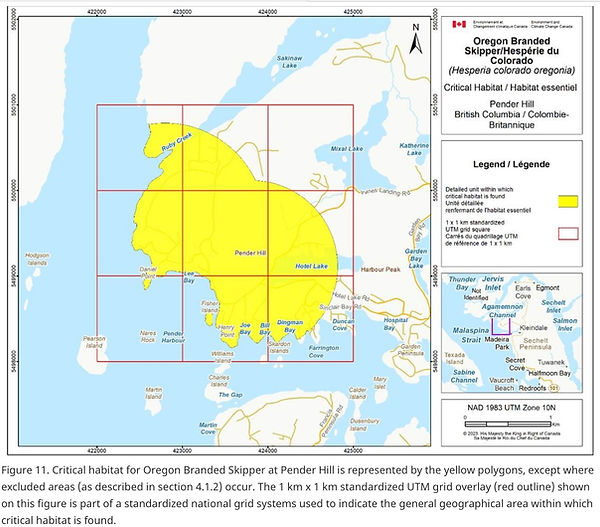
The discovery of Oregon Branded Skipper on Pender Hill, overlooking Hotel Lake is credited to Rand Rudland, a well known naturalist on the Sunshine Coast. Subsequent to this discovery, the Oregon Branded Skipper became an integral component of the newly established British Columbia Key Biodiversity Area #320 which involves most of the west side of the Sunshine Coast between Pender Harbour and Edgemont.
_Pender%20Hill%2013-08-2017.jpeg)
Photograph of an Oregon Banded Skipper taken by Rand Rudland on August 17, 2017 on Pender Hill in Garden Bay.
This webpage will include a narrative, written by Rand Rudland about how he discovered Oregon Branded Skipper. We will also touch on the other Moth species that are known to live around Hotel Lake and how they differ from butterflies. But first let’s focus on the Oregon Branded Skipper (OBS).
Range
OBS historic ranges are on Vancouver Island from Nanaimo south into the Cowichan Valley and Victoria to the Sooke Hills on southeastern Vancouver Island. It prefers sparsely vegetated dry coastal sand spits and Garry Oak ecosystems. The map below is very current and can be found in the first document in our “References” section below. Note #22 on the map; that's Pender Hill and Hotel Lake.

Habitat, and about Garry Oak Ecosystems
The endangered Oregon Branded Skipper (OBS) may be found in coastal Garry Oak Ecosystems on the scrub oak hillsides where larval caterpillars feed on various grasses. OBS prefer sparsely vegetated coastal sand ecosystems with large areas of exposed bare ground, dry well-drained soil, and various grasses, short-turf grasses and sedges including fescue, brome, bluegrass, needlegrass, beardgrass and bunchgrass. Bunchgrass is important for larvae, as the species is known to construct larval shelters using these types of grass species.
If all that sounds, to you, like the top of Pender Hill, then you have most likely figured out that Pender Hill is precisely where our subject, the Oregon Branded Skipper, was recently discovered on August 13, 2017.
Appearance
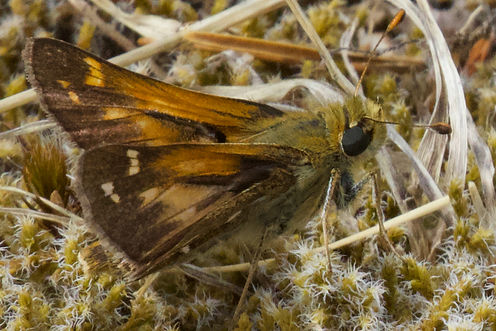
Oregon Branded Skipper are small, with reddish-orange to tawny wings with wide dark-brown borders.
Their antennae widens at the tip which resembles a club with a hooked, pointed tip.
Their forewings are triangular and overall wing spans range from 2.2 to 3.8 cm with females being typically larger than the males.
Both sexes appear similar in colouration, but males have a distinct dark stigma (stream or patch) on the dorsal (upper) forewing. The upper surface of the dorsal wings feature vibrant colours used for mating displays, sexual signalling, and mate recognition. Dorsal wing surfaces, in both sexes, have a reddish-orange base colour, broad dark brown margins, and lighter-orange spots.
The dorsal side is generally exposed only when the wings are open (in flight).

Life Cycle:
Egg Stage (Summer through Winter and Spring):
In late summer males perch on host plants such as native bunch grasses and long grasses, in dry sunny meadows, while females oviposition (lay eggs) singly on or nearby host plants. Eggs are tiny (1 mm), dull chalky white, changing to pink and then to pearly grey as they age. Unlike many insects, this species overwinters as an egg.
Larva (caterpillars) Stage (Spring):
In early spring the eggs hatch and the larva begin to feed, primarily on nectar? Larvae are known to construct small tent-like structures for refuge.
Larvae go through six instars (periods between moulting) over several months. They are nocturnal feeders and construct small tent-like shelters by webbing-together blades of bunchgrass. During the first instar larvae are pale beige. As larvae grow and moult, their head colour becomes tan to black and the body colour green to tan as they grow to 30 mm in length and 6 mm in wide. In the last instar, they are reddish with black spiracles, turning brownish-purple just prior to pupation.
Pupal/Chrysalis Stage (July to August): The larva pupates inside a silken shelter at the base of host plants or in leaf litter. This stage lasts for roughly 6-8 weeks, starting in early July. Pupae are approximately 20 mm long and 6 mm wide, have bluish-black wing cases, dull pink abdominal segments and a double row of transverse fuscous dashes along the sides.
Adult Stage (July to September): Adults emerge between mid-July and late September. They are nectar feeders, often found on plants like Oregon gum weed and black knotweed. Males are territorial, patrolling for females in sunny, open areas.


How the Oregon Branded Skipper was found on Pender Hill
We are grateful to Rand Rudland, B.Sc., MD for sharing and allowing us to publish the full story of how he discovered OBS living on Pender Hill. You will certainly sense his commitment as a naturalist and appreciate his continuing contribution to the collection of data about the natural environment on the Sunshine Coast.
Rand Rudland
“Oregon Branded Skipper – a first for mainland BC – I think!!
On the week leading up to August 13th, 2017, I had been made aware of an uncommon butterfly on Pender Hill—the Anise Swallowtail. As I had been unable to photograph this species on the Sunshine Coast I decided to make a quick trip up Pender Hill. ( I could do that in those years!). While I was there, I did a bit of exploring as I hadn’t been up there for many years and it was a beautiful, warm, sunny day with little wind—a perfect day for finding and photographing butterflies.
I arrived at the top around 1:30 and decided it was time for a short lunch before starting to look around for the Anise. While sitting in the shade of a now-almost dead Arbutus I could keep an eye on the field of grasses below me in case anything of interest might flutter by. Nothing much was flying so I finished lunch and began to wander about the grasses. No swallowtails to be found. A few dragonflies were flying frenetically about as they are wont to do, but none had landed for a photo, and I didn’t have my net with me at that time. So I kept looking.
I had wondered over towards the parking lot exit as I had not bothered to spend much time there on my way up. The moss-covered rocks and grasses were mostly in the shade at the time, and the open areas had beckoned—and I was a bit hungry for a late lunch. The light was now better and there was a small grassy area and a nearby exposed dry moss bed on partially exposed rock. At 1:50 I saw a skipper resting on a stooped piece of grass, always worth a photo (photo #1). Then I noticed a couple of skippers alighting intermittently on the dried moss, so I moved towards them. There were a couple of swallowtails working the perimeter of the opening, but again, never landing.
Then as is often the case, things happen in a flurry. Five or six skippers landed on the mosses that I was sitting near, and all, I assumed, were Woodland Skippers, the only light orange-brown skipper species on the Sunshine Coast. Trying to photograph as many of them as I could, I took a few hundred photos before they all flew off and I moved back to the more open area to continue looking for my target species, the Anise Swallowtail.
Ten minutes or so later I was finally rewarded with an Anise resting out in the open on the lower branches of a Shore Pine, and my day was a success (photo #2). Time to head home, cull my photographs, and submit my day’s sightings to iNaturalist. But I had “skipped over” a few photos taken that day as I fully expecting all the skippers to be Woodland Skippers. When you are reviewing hundreds of photos, this can happen. Fast forward a bit.
On July 6th, 2020, I was back up the Hill with no particular goals except that it was a beautiful day with no wind, and it was time for butterflies to start appearing. And they did. Again, lots of Woodland Skippers, but one looked a bit different! Subtle pattern differences in the underwing made me hesitate in my ID, and I had put it down incorrectly on iNaturalist as a Common Branded Skipper, which would have been a new arrival for the Sunshine Coast, but here is where the beauty of the iNaturalist platform shows itself. I sent a photo to Crispin Guppy, the author of “Butterflies of BC” with a link to my sighting, and he quickly identified it as an Oregon Branded Skipper (photo #3). WOW! A new subspecies for the British Columbia mainland, “imperilled” in Canada, and right here on the Sunshine Coast.
The epilogue to this story is that three years later in 2020 I was going back over butterfly photos that I had taken on that earlier Anise Swallowtail search day, but had not entered into iNaturalist, and I came across a photo that was also an Oregon Branded Skipper (photo #4).
So, the moral of the story is, you never know what might show up when you’re out exploring, and always remember that, even if you are not certain of an ID, someone in the iNaturalist realm will. And it just might be the next “new arrival” of an insect, bird, plant or “anything with DNA”. Keep on looking!”
Rand Rudland, B.Sc., MD
Skippers …..vs moths and butterflies - to help you on your next walk!
Skippers and moths are both butterflies but different in many ways.
Skippers and moths both have stout bodies.
Skippers are generally smaller than moths.
Skippers have distinct, smooth antennae that end in a club with a hooked, pointed-tip while moths have feathery, comb-like, or simple, non-clubbed antennae.
Skippers fly fast and dart-about erratically (“skipping”) and are highly visible because they fly during the day. Moths, on the other hand, are primarily nocturnal and thus are rarely observed in flight.
When resting, Skippers often hold their wings in a V-shape, angled upwards while moths usually fold their wings flat over their bodies.
For an excellent in-depth overview about local Moths and Butterflies, we recommend the following video created by Sunshine Coast Botanical Garden in which Rand teams up with Tony Greenfield for an in-depth presentation on this subject.
We hope you will enjoy watching:
Butterflies of the Sunshine Coast with Rand Rudland and Tony Greenfield
At Risk? Is OBS and endangered butterfly in British Columbia?
Historically, First Nations peoples set controlled fires to maintain open Garry Oak meadows but today, wildfire suppression is essential for human safety. The remaining open Garry Oak meadow areas are filling in with trees and shrubs and urban development on southeastern Vancouver Island has eliminated much of the otherwise available dry-meadow habitat of the Oregon Branded Skipper.
In the remaining habitats, the abundance of native bunch grasses as nectar sources has been reduced by the introduction of non-native grasses, Scotch Broom, and other invasive plants.
No populations of Oregon Branded Skippers are known to exist on sites that are now dominated by non-native grasses.
Yes, this species is at risk in Garry Oak and other associated ecosystems in British Columbia.
Table 1. Conservation Status of Oregon Branded Skipper (from NatureServe 2023, and B.C. Conservation Data Centre 2023)

References:
Government of Canada, Oregon Branded Skipper (Hesperia colorado oregonia): recovery strategy [proposed] 2025 Species at Risk Act Recovery Strategy Series Adopted under Section 44 of SARA, Proposed 2025
Acknowledgements: Development of this recovery strategy was coordinated by Environment and Climate Change Canada, Canadian Wildlife Service (ECCC CWS) – Pacific Region staff: Cindy Bertrán Cerino, Jared Maida, Linda Takahashi and Eric Gross. Megan Harrison (ECCC CWS-National Capital Region) provided helpful expertise and advice on drafts of this document. Danielle Yu (ECCC CWS-Pacific Region) provided additional assistance with critical habitat identification, mapping, and figure preparation. Jennifer Heron (B.C. Ministry of Water, Land and Resource Stewardship) provided helpful expertise and advice on drafts of this document. Crispin Guppy generously provided critical expert advice on specific topics related to critical habitat. iNaturalist staff James Pagé and Allison Siemens provided help gathering observation data. Huge appreciation to all iNaturalist observers: Steve Ansell, Mark Wynja, Sean McCann, Thomas Barbin, Jeremy Gatten, and Rand Ruland for collaborating as citizen scientists and provide useful observations to inform critical habitat for this species. Special thanks to Mark Wynja for his generosity sharing the cover page visual for this document.
Sonora Skipper & Oregon Branded Skipper: Conservation Status Update for Two At-Risk Butterflies in Washington State: Ann Potter, Insect Conservation Specialist, WA Department of Fish & Wildlife, Olympia, WA with Thor Hanson & Loni Beyer:
Washington Department of Fish and Wildlife, Oregon Branded Skipper: https://wdfw.wa.gov/species-habitats/species/hesperia-comma#desc-range
COSEWIC Assessment and Status Report on the Oregon Branded Skipper: https://publications.gc.ca/collections/collection_2014/ec/CW69-14-680-2014-eng.pdf