
Plant Life

There is a plethora of plant life around Hotel Lake. We plan to present these on three webpages:
Plant Life (this page)
Invasive Fire Hazards & Poisonous
This page is titled Plant Life and, over time, we hope to present condensed studies of local plants. As we publish each plant study, its name will appear on the list immediately below and by clicking on the name of the plant that you would like to read about, you will be taken directly to that study.
Western Skunk Cabbage
(Lysichiton americanus)


WESTERN SKUNK CABBAGE (Lysichiton americanus) If Skunk Cabbage could speak in its own defence it would say that it doesn’t smell nearly as bad as its name suggests. Although we may not love the odour, the bright yellow colour of the Skunk Cabbage appears very early each year and reassures us that spring is on its way. Around Hotel Lake, we notice Skunk Cabbage in the wetlands on the north side of Beaumont Rd and in ditches, along streams and in other muddy, wet, marshy places in the area. RANGE: The range of Western Skunk Cabbage through western North America extends from Cook Inlet, Alaska, south through British Colombia and the Pacific Northwest states to Santa Cruz county, California. CHARACTERISTICS: Western Skunk Cabbage, also known as Swamp Lantern, is a perennial plant that grows from a rhizome. It has been known to grow to 5 ft. tall and has the largest leaves of any native plant in its region. At the top of a stalk you will find a spathe and a spadix. The 2 to 5 inch thickening at the end of the stalk, the spadix, is the flowering part of the plant. It is actually densely packed with tiny yellow-green or pale yellow flowers. These are male and female flowers but the timing of their appearance is such that the plant cannot self-pollinate, but must have pollen from a different spadix. Wrapped around the spadix is the bright yellow spathe. This large, colourful, leaf-like surround serves to protect and also to attract possible pollinators. SMELL: The smell is mainly produced by the spadix and is strongest when the plant is in bloom. Leaves can also contribute to the smell if they are bruised or broken. The smell reminds people of rotten meat…and the question is…why would a plant want to emit a putrid, meat smell? The answer is that this is part of a clever ploy. Skunk Cabbages depend on pollination by insects. POLLINATION: The insects that are available so early in the season when the Skunk Cabbage is in bloom are beetles and flies. These insects, particularly the rove beetle, are looking for decaying animal carcasses. The rotting, decaying smell of a Skunk Cabbage is irresistible to rove beetles. They beetle to the spadix (excuse the pun), find pollen to eat and a safe place to mate. In the process they move the pollen between male and female flowers accomplishing pollination of the Skunk Cabbage….a mutually beneficial arrangement. After pollination, each little flower develops into a berry with one seed. The surrounding spathe withers and falls away. The berries continue to ripen until late summer. By this time the spadix has turned black. It disintegrates and the seeds drop into the mud. By early September, the large green outer leaves are turning brown and decaying until no foliage remains. However, in the mud the rhizome is alive and will sustain the plant through to bloom the following spring. CONCERNS: Of concern is the fact that Skunk Cabbage contains calcium oxalate. Which means that Skunk Cabbage is poisonous and “moderately harmful” to humans, cats, dogs, and other mammals. In small doses, the plant can cause burning and swelling in the mouth and a choking sensation. Eating larger portions of Skunk Cabbage leaves would cause death but sources state that Skunk Cabbage tastes so bad it would be unlikely that anyone could consume enough to be fatal. On the plus side, “this is an important native plant that supports the health and proper functioning of stream habitats and forested wetlands.” As well as the pollen which is a food source for insects, its stem and seeds are eaten by bear (especially as they emerge from hibernation) deer and elk and various wildlife species. Amphibians and insects take shelter under its large leaves, and its decaying foliage provides important nutrients to the soil. Should you wish to read more about the Western Skunk Cabbage, an interesting section on the impact of climate change on this plant can be found at the end of the article at this website: https://www.oregonencyclopedia.org/articles/skunk-cabbage/

Western Sword Fern
(Polystichum munitum)

Those who live near Hotel Lake are also living close to natural wildlife and plant life that make up our local environment. A little light-reading on our website can transform your walk through our forest trails into an adventure of discovery. Learning which plants are indigenous will provide you with greater insight and sensitivity concerning the encroachment of invasive species.
In the shady-green depths of our west-coast forests you will find a variety of ancient ferns that beg our attention.
So attractive and beautiful are these carpets of ferns that many of us may have incorporated them into our gardens as background or foreground features and, as long as there is not too much sunlight, these ferns will thrive. Ferns have a very successful relationship with our environment that originated around 400 million years ago.
There are many different types of fern; here is a very short list of ferns we might see locally:
Western Sword Fern is very common in conifer forests.
Liquorice Fern grows on mossy trees and rocks.
Deer Fern is small and found in damp, shady areas.
Lady Fern is large, deciduous found in moist, open woods.
Giant Chain Fern is the largest (8 feet) in moist, coastal habitats.
Spreading Wood Fern is found in forests and rocky slopes.
We have chosen to focus on the extraordinary natural history and modern success of the Western Sword Fern which we see all around us.
WESTERN SWORD FERN
Arching, dark-green, sword-like leaves (fronds) grow-stiffly from a large brown rhizome. The leathery fronds can be up to 1.5 metres long and 25 centimetres wide. Mature plants can have a over a hundred fronds.

RANGE
In B.C., the Western Sword Fern predominantly a coastal species, but its range also extends across the extreme southern portion of the province. It thrives mostly in the moist humus of conifer forests.In B.C., the Western Sword Fern predominantly a coastal species, but its range also extends across the extreme southern portion of the province. It thrives mostly in the moist humus of conifer forests.The Western Sword Fern also grows from Alaska to south California, mainly in coastal or moist areas. It is often seen growing in clumps covering the a damp forest floor under a shady canopy of Western Red Cedar.

WESTERN SWORD FERN - About
Arching, dark-green, sword-like leaves (fronds) grow-stiffly from a large brown rhizome. The leathery fronds can be up to 1.5 metres long and 25 centimetres wide. Mature plants can have a over a hundred fronds.
The lower third of each frond consists of a scaly brown stem called a stipe. The upper two-thirds of the frond bear numerous pointed and toothed pinna (leaflets). Each pinna has a small, sharp "hilt" at it’s base. The edges of each pinna are sharply serrated which can help to distinguish it from other ferns.
On the underside of each pinna (leaflet) are two parallel rows of dots. These dots are called sporangia capsules and they contain, and eventually release, microscopic spores needed for reproduction.
Anchoring the fern’s-clump are a tangle of wandering roots that emanate from a central rhizome at the base of the fern. These roots help stabilize the soil and resist soil erosion.
Western Sword Fern typically grows into a mounded clump with new fronds issuing out of the centre. Old and dead fronds are pushed aside and lay closer to or on the ground surrounding the edges of the fern. Mature plants are known to live for 100 years but many sources suggest that they can live considerably longer.
REPRODUCTION
Western Sword Fern has a complex life cycle which is at the centre of its ability to survive for millions of years. Ferns were some of the first vascular plants (Plants with stems and leaves) that formed the world’s earliest forests, survived a few mass extinctions, diversified and also kept pace with evolution. Some ferns took to the forest canopies as epiphytes. A local example of this is the Licorice Fern, which grows among thick moss mats on trees. Others, like the Western Sword Fern, proliferate on shady forest floors.As a fern, our subject produces no flowers or seeds; instead, they disperse spores. We found and excellent summary of this in Neighborhood Naturalist Magazine: Winter 2016-17 v14 #4 • page 1. With thanks, we include the diagram from that article and the numbered paragraphs below are transcribed for easier reading.

“Unlike seeds, fern spores aren't ready to grow into mature plants. Instead, they're the start of a multi-step reproductive process. Even though it's extremely unlikely that any one spore will result in a fern, sword fern is able to dominate landscapes.
1. The little “grains” of the sorus are tiny, but they aren't actually the spores.
They're sporangia, capsules that contain the microscopic spores.
2. When mature, the sporangia forcibly pop open, scattering spores to the wind. Most mature by midsummer. Some overwinter, and mature in early spring.
3. A spore grows into a haploid plant (one set of chromosomes), called a gametophyte or prothallus. It grows to about 1 cm wide, and has numerous structures for sexual reproduction. The female structures are called archegonia, and the male structures are called antheridia.
4. When the coil-like sperm are released from the antheridium, they need wet conditions to swim. One finds its way into an archegonium and fertilizes the egg. Typically, the sperm from one gametophyte will swim to a nearby gametophyte to fertilize the egg. It's rare for a gametophyte to fertilize itself.
5. A young diploid plant (two sets of chromosomes), called a sporophyte, grows out of the archegonium on the gametophyte.”
6. The sporophyte matures into the familiar fern plant. Pictured here is the underside of one frond. Some individual plants can produce tens of millions of spores.
After fertilization, new fern-fronds start to grow vertically as curled stems, called “fiddleheads”. Because the new fern is a product of two gametophytes, it has a very healthy genetic diversity that rivals many seed-bearing plants.
The following video from natureclearly.com is also very illuminating:
I'm a paragraph. Click here to add your own text and edit me. It's easy.
RECIPROCAL RELATIONSHIPS
The Western Sword Fern is a competitive survivor that benefits our natural landscape and the wildlife that live there. It’s fronds create branch-covered areas that create habitat and cover for ground-nesting birds, small rodents, salamanders and snakes that dwell on the forest floor. It is a food source for larger wildlife, such as the mountain beaver a secretive, rabbit-sized, burrowing rodent that lives deep in the Pacific Northwest rainforests. Roosevelt Elk may eat sword fern in quantity during winter and spring, and Blacktail Deer will also nibble at it throughout the year. It can be used by wildlife in other ways; black bears use the fronds to line their winter dens.
It has commercial value for florists who use the deep green fronds in
their arrangements and wreaths. Gardeners, often plant these ferns as they are attractive and native to our landscapes; once established, it’s an easy-to-maintain ground cover that stays green year-round.
Indigenous peoples used these ferns to cover or layer food for storage, to line cooking pits and for many other uses. Various parts of the plants were used as a medicine for ailments like diarrhea, sore throats, tonsillitis, and sores. It was used to treat pain during labor, or to treat pain in general.
Toxicity is a concern. Consuming these rhizomes for food was probably limited to times of desperation or famine. Today there are various perspectives on the modern use of these ferns for food. Depending on type, preparation and cooking methods, fiddleheads should still be considered as possibly toxic including the water it was cooked in. Every year, a number of food borne illness outbreaks or food poisonings have been reported in Canada and the United States due to “improper preparation of fiddleheads”. The stated cause of these illnesses is an unidentified natural toxin in fiddleheads.
Given the fact that many fern species are toxic, and may require specific processing before eat, it is probably wise to avoid consuming it.
GARDENING
Throughout the Northwest and beyond, Western Sword Fern is commonly re-planted or grown from a piece of rhizome. Useful for landscaping, if you plant a fern in your yard, you will enjoy its company and appreciate the roll it plays on earth; and, you can expect that it will likely out-live you!
STATUS
COSEWIC: Not Reported
CDC: Yellow

DIE-BACK?
Here is something rather disturbing! Some years ago folks down in the Seattle-Puget Sound area began seeing Western Sword Ferns in distress and over time large patches of fern were turning brown and dying. Many concerned citizens began collecting data and in the following years tried to establish how big the problem was while at the same time trying to get government attention. As part of these efforts a portal was created on iNaturalist where citizens can report and send photos.
If you would like to know more about this dramatic “die-back”, here is a crash course that will only take you a few minutes. Start with this link to Washington State University’s web page.
https://treehealth.wsu.edu/fern/
Then if you see what you think might be “Dieback”, all you need to do is take a couple of good photos and make a report via a link to iNaturalist. That link is below.
iNaturalist Report.
https://www.inaturalist.org/projects/western-sword-fern-decline-in-the-pacific-northwest
REFERENCES:
Neighbourhood Naturalist Magazine, winter 2016: https://drive.google.com/file/d/0B-2CKm01fUqVWUpfVE44Q0ZiNmM/view?resourcekey=0-CYB0NCnFNo0e0rnYiwcoCw
Native Plants Pacific North West: https://nativeplantspnw.com/
Neighborhood Naturalist: http://neighborhood-naturalist.com/
Rebecca Lexa Naturalist: Excellent guide to identifying plants and terminology: https://rebeccalexa.com/how-to-identify-western-sword-ferns/
Western Sword Fern Dieback Research, by Washington State University Urban Forest Health Lab: https://treehealth.wsu.edu/fern/#:~:text=Western Sword Fern (Polystichum munitum) Western sword,forests, holding cultural, ecological, and economic value.
Horsetail
(Equisetum) “Scouring Rushes”


Horsetail (Equisetum) “Scouring Rushes” Horsetail comes from a prehistoric plant family dating back 230 million years. It dominated the planet as prehistoric trees and for the past 30 million years is believed to have contributed greatly to the formation of Earth’s present-day coal deposits. Today, nine modern Horsetail species are almost indistinguishable except for slight differences apparent at stem joints. Horsetail tends to grow in moist areas, wet grasslands, stream banks, wetlands, marshes, ditches, damp sandy or disturbed sites and shady forests throughout BC. Horsetail has a horizontal and deep root system with rhizomes that can spread and produce many stems that appear in the Spring. Horsetail sends up both fertile shoots, that distribute spores, and vegetative shoots. The fertile shoots are first to appear. They have light-brown stems with no branches but have a spore-bearing cone at its tip. They grow to about 12 inches tall and in a general way, resemble asparagus. These fertile shoots release tiny spores from their cone into the surrounding area and then promptly wither away. The released spores are tiny (0.05 mm) and generally fall to the ground. They have evolved amazing adaptations that increase their mobility to disperse in ways that we are just beginning to understand. When the spores take root they continue the cycle, spreading as creeping rhizomes and tubers. Shortly after shedding their spores, the fertile shoots die back and vegetative shoots begin to emerge. These are more numerous and grow to 2 feet tall and produce “whorls” of fine green branches (modified leaves) that form at stem joints to create bushy plants which resemble miniature pine trees. This pine tree appearance helps us to differentiate them from ferns. They are delicate and soft. When full grown in mid-June, especially where they have well established root systems, they often grow in a colony or great carpet which can impart a rather enchanting elfin-glade aura in a forest setting. Food for Wildlife? The new, fresh Horsetail shoots are an important early spring food source. Bears, Moose, Elk, caribou, geese and other wild animals are believed to eat Horsetail. Bears, it has been noted, only eat Horsetail in the spring when the plants are young. Horsetail can be toxic or fatal for domestic horses, cattle and sheep, usually when consumed in hay that contains Horsetail. Food for Humans? Bears only eat Horsetails in the spring when they are young and fresh shoots. Part of the reason that bears do not touch Horsetails after early June is the plant has an unusual attribute in that it extracts silica out of the soil and over time becomes increasingly saturated with silica. When Horsetail dies in the fall, it turns white because the absorbed silica is almost all that is left. At this point the plant feels sharp and coarse and can actually cut holes in the digestive tract of anything that eats it. This is how some plants in the family got the name “Scouring-Rush”; in mid- to late-summer, they were used as scouring pads to clean pots by western pioneers, and even used as sandpaper. Indigenous people used them to polish arrows, bows and pipes. Horsetail has many uses as a fungicide, and for various garden applications, and also has numerous herbal and medical uses. An incredible array of bioactive chemicals are present in Horsetail, and the plants are used medicinally by humans in every region that it grows. The use of Horsetail by humans is a topic that goes far beyond our mandate to gather and share information on wildlife and plant life and the dangers thereof. Horsetail is a complex plant requiring careful and diligent study by anyone planning to consume it.
Red Huckleberry
(Vaccinium parvifolium)


RED HUCKLEBERRY (Vaccinium parvifolium) Hundreds of species of both red and black huckleberry plants can be found world-wide Red huckleberry thrives in our coastal coniferous forests in the Georgia Depression and coastal mountains, often found growing out of rotting logs and stumps. Here on the Sunshine Coast it is the Red Huckleberry plant that you will most likely see growing as a shrub. STEMS, LEAVES AND FLOWERS: They normally grow to a height of about 1-2 metres, but in perfect conditions, they may grow as high 4 metres. It has bright green branches with surfaces that are angled. Plants located in direct sunlight may have red coloured branches.. Its dainty leaves are 3 cm in length, oval-shaped and not-toothed. Leaves alternate on the stem and are usually bright-green but sometimes red. Red huckleberry will sometimes keep its leaves over winter. It’s flowers are small and urn shaped; colouration is greenish-yellow, often with a lovely pink hue. Flowers bloom in April-June. Fruit ripens in July and August when flowers grow into small bright red berries. As this is the only native upright Vaccinium with red berries, it is most easily recognized when its bright red berries are ripe. FOOD FOR ANIMALS: A large number of birds eat Huckleberries: Thrushes, catbirds, bluebirds, towhees, ptarmigan, pigeons, turkeys, blue, ruffed, sharp-tailed, and spruce grouse, gulls and cranes. Birds that eat Huckleberries play an important role in spreading the berry seeds. Large mammals that consume Huckleberries include black and grizzly bears, deer, moose, and cariboo, small mammals such as ground squirrels, raccoons, foxes, opossums, skunks, and marmots, and even mice and chipmunks. And even domestic livestock such as sheep and, occasionally, cattle will eat red huckleberries. Insects and wild bees work the flowers for nectar. Most notably, a single black bear may eat more than 30,000 huckleberries a day in mid summer. Grizzly bears also feed on huckleberries. FOOD FOR HUMANS: Huckleberries have long been a preferred food for human use. Red huckleberries are quite tart, while black huckleberries are slightly larger and sweeter. Huckleberries have long been eaten by many coastal First Nations peoples. Red huckleberries are a good source of vitamin C. They can be eaten fresh, dried, or used to make pies, jams, jellies, or wine. Fresh huckleberries are eaten while in season, with the majority canned, frozen, jammed or dried for the winter months. Rich in antioxidants, Huckleberries are known to boost immunity and healing. Cultivation of this particular plant into your home-landscape is quite feasible. Keep in mind you will likely be attracting wildlife. AT RISK?… COSEWIC: Not at Risk, CDC: Yellow. Currently, in BC, Huckleberries are not at risk. However, vigilance aimed at protecting huckleberries from the threat of invasive species is important if we are to preserve this food source for humans and wildlife.
Salal
(Gaultheria shallon Pursh)
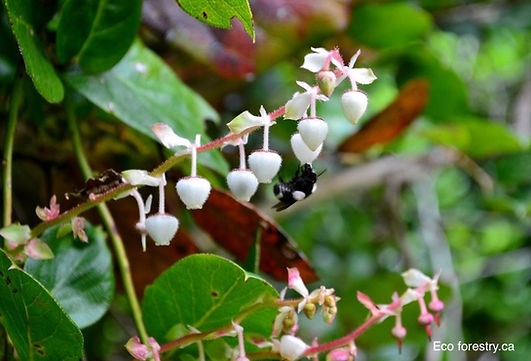
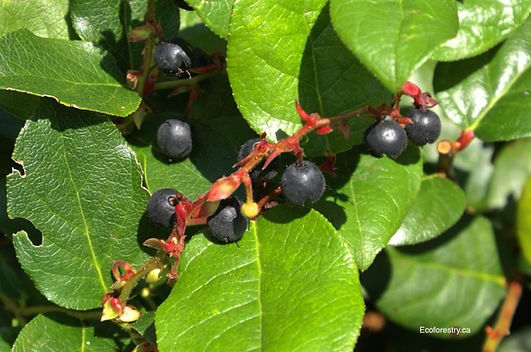
SALAL (Gaultheria shallon) A member of the heather family (Ericaceae), Salal is related to arbutus, rhododendron, blueberries, kinnikinnick, manzanita, and other species of our region. Salal’s beautiful evergreen leaves are large, oval, thick and leathery, with finely toothed edges and have a waxy bright-green shine. In a perfect mix of sun and shade, this plant can grow to a height of 2 metres. Salal is both moisture tolerant and drought resistant. As an evergreen, it keeps its leaves all year. Aggressive underground roots ensure the plant expands and thrives wherever it can. In the summer bell-shaped pinkish-white blossoms appear and in the late summer and fall the plant produces large dark red to dark purple berries. After being cut, Salal will stay fresh looking for months making it valuable to florists. Historically and in present times, Salal continues to have considerable value as a food and medicine for both humans and animals. All of this demand has resulted in extensive harvesting of Salal which is classified as a “special forest product” in British Columbia. Salal for Animals: Large Salal concentrations provide important cover-shelter and shade for elk and deer, birds, and small mammals such as snakes and newts etc. Salal is also the host plant for Brow Elfin Butterfly larvae. As a food source many animals such as deer, elk and bears feed on the twigs while the copious concentrations of berries attract the attention of black bears, squirrels, chipmunks, foxes, and coyotes. Salal for Humans: Food or Medicine …or Both Salal is a highly valued food for Northwest Coast First Nations Peoples. More than just a food it is also used as flavouring, a thickener and a sweetener. The branches and leaves of salal are used to line cooking pits and provide flavour. As a medicine, Salal is used for colds, digestion, coughs, burns and wounds. Leaves are used to cover cuts and wounds. Recent research found both tannins and anthocyanin levels in Salal greater than in blueberries; both have been correlated with reduced risk of stroke and neurodegenerative and metabolic disease. Late in the season, Salal berries, growing in clusters on the tips of the branches, ripen to a dark purple, almost black and have a slightly fuzzy skin. When picked early they can taste somewhat astringent or underripe. It is when the berries are plump and come off the stem with a gentle pull that they taste sweet with a mild pleasantly earthy undertone vaguely reminiscent of blueberries or blackcurrants. To get the best taste, wait until the berries are plump and almost ready to fall off the stem. Endangered? Not surprisingly, in recent years, the harvesting of Salal has been increasing with valuations estimated in the millions. Although it is referred to, in B.C., as “a special forest product”, harvesting is completely unregulated. More disturbing, the industrialization of Salal is without any policy initiatives to protect the species. Demand is known to be increasing and, it is already becoming evident that Salal might be failing to meet current commercial demand at the end of each season. There is, of course, the traditional uses of Salal by indigenous peoples. Also Salal must continue to meet the food needs of wild animals. Is Salal is endangered or threatened? This question begs an answer. The time for further study and the development of harvesting protocols and practices has arrived. ECOFORESTRY Institute Society: https://www.ecoforestry.ca/plant-of-the-month-july BC Food History: https://bcfoodhistory.ca/salal/ BC Adventure: http://www.bcadventure.com/adventure/wilderness/wildflowers/salal.htm E-Flora BC: https://linnet.geog.ubc.ca/Atlas/Atlas.aspx?sciname=Gaultheria shallon British Columbia Magazine: https://www.bcmag.ca/bcs-salal-berries/
Oregon Grape


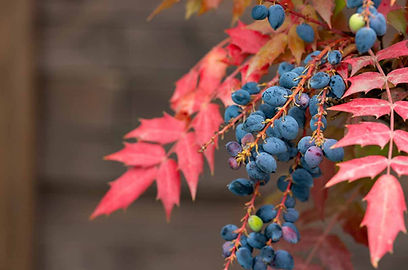


OREGON GRAPE Oregon Grape, a plant native to the west coast of North America, is easily recognized by its evergreen, holly-like leaves, yellow flowers and bluish-black berries. In 1806, it was described in Lewis’ journal during the Lewis and Clark expedition up the Columbia River in Oregon. In 1899 it became the state flower of Oregon. Although Oregon Grape might be mistaken for English Holly, a closer look reveals two major differences. The leaves of the Holly come off the stem alternately one on the left, then, further along one on the right (alternately). The Oregon Grape leaves both come off the stem, right and left at the same point (opposite). Later in the summer the difference is more obvious as Holly berries are red and Oregon Grape berries are blue. There are several different species of Oregon Grape. In BC there are two main types: Tall Oregon Grape (Mahonia aquifolium) which can grow up to 8 feet tall, and Dwarf Oregon Grape (Mahonia nervosa), a common lower-growing species of 1 to 2 feet in height. Comparing the appearance of these two varieties, the leaves of Dwarf Oregon Grape are longer and less shiny (dull). This Dwarf Oregon Grape is more likely to be found growing in the wild and is frequently seen in the Hotel Lake area. In spring new bronze or copper coloured leaves appear on this plant, as well as clusters of softly scented yellow flowers. By summer the leaves have turned dark green and the flowers have been replaced by clusters of small, dark blue grape-like berries. By fall, the leaves are turning colour becoming shades of red, burgundy and bronze. Some plants retain berries through the winter along with these reddish leaves. Oregon grape is a highly adaptable plant. It thrives under coniferous trees, particularly as undergrowth at the base of Douglas fir trees. It is found in open woodlands, scrublands, at the edges of meadows and on sagebrush hills. It prefers well-drained acidic soil, and partial shade, but once established it can tolerate a range of soil types, partial shade to full sun and drought. Oregon Grape has two methods for spreading. To become a larger clump, the plant develops underground stems called rhizomes. These stems grow laterally in the ground, send up shoots and develop roots. To develop plants in another location, the plant relies on the seeds in its berries. These seeds are eaten and then dispersed by birds and animals. Benefits of Oregon Grape The following quote concerns how beneficial Oregon Grape is to wildlife and is taken from the website “Real Gardens Grow Natives”: “Like all native plants grown where they evolved, Oregon Grape plants are extremely beneficial and attractive to wildlife. Flowers provide for pollinators like bees, moths, butterflies and hummingbirds while the fruits, which may remain on the plant into winter, are favourites among birds such as towhees, robins, and waxwings, as well as mammals. Some butterfly and moth species rely on Oregon Grape plants to host their larvae, including the brown elfin butterfly. Year round cover may support arthropods, birds, reptiles, amphibians and small mammals.” The Indigenous people in the Pacific Northwest have a long history of using the berries, leaves, roots and stems of Oregon Grape for a variety of purposes: - Although the berries are sour, they can be eaten raw or dried or made into jams and jellies. A website providing a recipe for jelly can be found in the references at the end of this article. - Shredded Oregon Grape bark was used to make a bright yellow dye which they used to colour basket-making materials and wool. -The root was often used to make a bitter tea that served to address digestive issues. Other parts of the plant were used medicinally to treat infections and skin conditions. Herbalists value Oregon Grape because it contains a complex compound called berberine. Claims are made on behalf of this herb that suggest it relieves some skin conditions and supports digestive health and liver function. More research is required to substantiate these claims. Gardeners often choose Oregon Grape as a better solution to more invasive species. Also, it tolerates a variety of moisture and soil conditions, is low maintenance and deer resistant. Is Oregon Grape Invasive? The answer is “no”…not within the area where it is a native species. However Oregon Grape has been introduced into other areas such as northeastern North America and much of Europe. In these areas, it can out compete native vegetation and alter ecosystems. If you have ever tried to get rid of Oregon Grape you quickly understand that its root system and rhizomes make eradication a challenging task. References: https://realgardensgrownatives.com/?p=4268 https://www.wnps.org/blog/eating-native-recipes-from-the-field-oregon-grape-jelly https://www.thespruce.com/oregon-grape-profile-3269178 How to Grow and Care for Oregon grape https://gardenerspath.com/plants/ornamentals/grow-oregon-grape/